

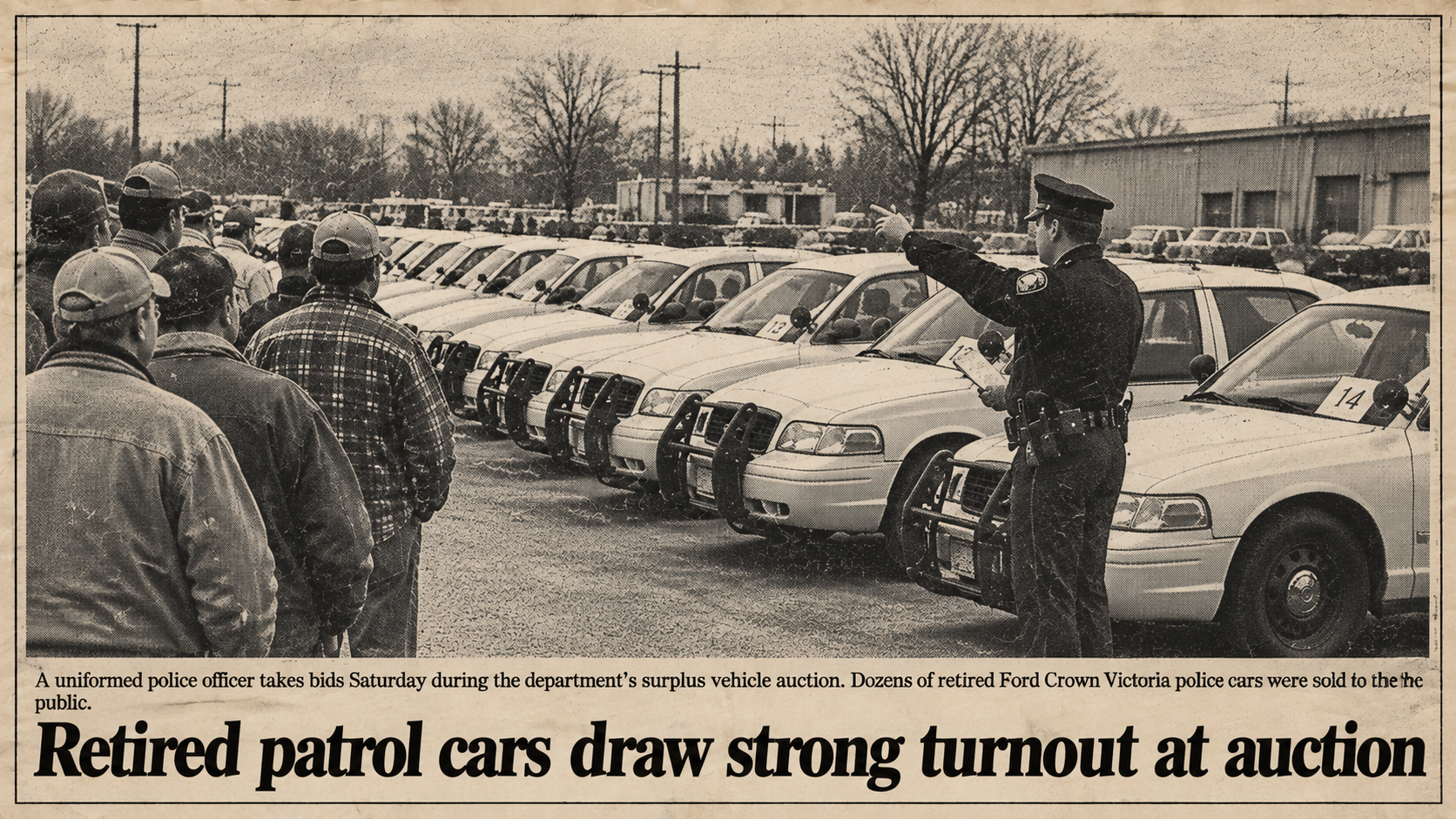

Before the Internet: The World of Government Auctions
Behind police stations, in government parking lots and municipal yards, government auctions were happening across America. Finding the best ones—and keeping that information from the competition—was part of the business.
UX AuctionsLong before surplus property was photographed, cataloged and searchable from a laptop, government auctions were already happening everywhere. Police departments lined retired cruisers behind their stations. Cities and counties filled municipal yards with trucks and equipment. School systems, utilities and public works departments accumulated whatever they no longer needed and periodically sold it. The sales were constant, but the information was scattered. There were no websites, no alerts, no saved searches—just newspaper ads, legal notices, radio announcements, flyers, mailing lists and word of mouth. And most of all, there were parking lots.
Government agencies wanted bidders, so they advertised. The information was public, but it was temporary and overwhelmingly local. A buyer had to see the ad, hear the radio spot, receive a notice or already know that a particular agency held auctions. A sale happening 100 miles away might as well have been happening on the other side of the country if nobody mentioned it. That made information valuable, and among professional dealers, a particularly productive auction wasn’t something shared casually.
Dealers built their own networks. They tracked which police departments replaced vehicles regularly, which municipalities sold equipment themselves, and which auctioneers handled specific government accounts. They watched newspapers, listened for ads, joined mailing lists, made phone calls and remembered what they learned. Finding a good auction meant finding a recurring source of inexpensive inventory. Telling competitors only created more bidders, and more bidders meant higher prices. The auction wasn’t secret—anyone could attend—but knowing which auction was worth attending was a competitive advantage.
The serious work often began before auction day. Many agencies offered inspection periods, giving buyers time to walk rows of vehicles and evaluate them. Police fleets often looked identical—same make, same model, same year, same color—but the cars weren’t identical at all. One might have been carefully maintained, another might have transmission trouble, another electrical issues, another years of hard patrol duty. Experienced dealers could tell the difference, and they didn’t always want an audience while they figured it out.
Members of the public noticed something else. Dealers looked like they knew what they were doing. A buyer who came to avoid paying dealer prices often ended up watching the dealers to decide which car to buy. If a dealer spent time inspecting a particular Crown Victoria, someone else suddenly became interested in it. If a dealer started bidding, people assumed there was a reason. Some simply asked the dealer what was good, what was bad, what something was worth. The irony was obvious: the buyer came to eliminate the dealer, then relied on him anyway. And none of it answered the real question—how much the dealer was actually willing to pay.
Among regulars, a different atmosphere developed. They saw each other at police auctions one weekend, county sales the next, municipal auctions after that. They were competitors, but they were also professionals trying to make a living. If one dealer was clearly pursuing a vehicle, the others understood. Nobody was obligated to stop bidding, but there was little reason to drive the price unnecessarily high just to beat someone. There would be another vehicle, and at another auction the roles might reverse. Dealers understood the math: transportation, repairs, detailing and resale all had to fit inside the margin. A member of the public buying one car didn’t need a margin at all. If he wanted the car, he might keep bidding long after every dealer had stopped, making him one of the most unpredictable people in the lot. The dealers weren’t there to win—they were there to make a living.
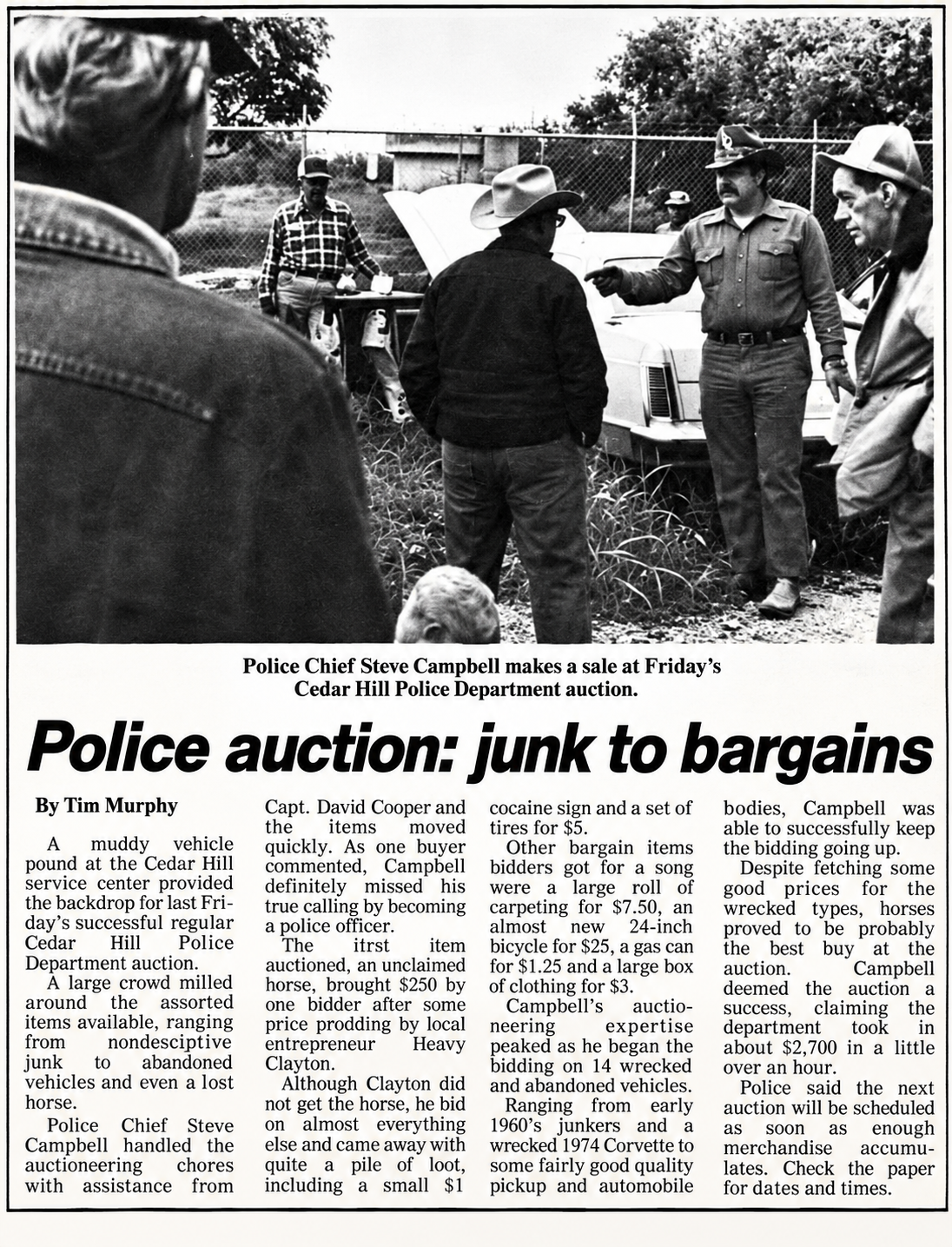
Cedar Hill Police Department auction, 1981. Police Chief Steve Campbell conducted the sale from the city vehicle pound—an example of how local government auctions were held before online bidding.
Not everyone followed the unwritten rules. Inspection periods sometimes produced questionable behavior. A buyer might move a power seat fully forward and disconnect it, making the car impossible for the next person to sit in properly. Minor interference could make a good vehicle appear to have electrical or mechanical issues. An inexperienced buyer might open the door, see something wrong and walk away. The person responsible knew better. It wasn’t legitimate strategy—it was dishonest—but it showed how valuable information became when everyone was competing for the same limited inventory. The auction might start Saturday morning, but for some people the games started days earlier.
Not all inspection-day antics were serious. One regular buyer used a pink Magic Marker to place tiny dots on the headlights of vehicles he wanted. It was his private watchlist—until other buyers figured it out. The dots began disappearing. New dots appeared on undesirable vehicles. His system was turned against him, and for a while the pink marker led him straight to the wrong cars. Today a buyer clicks a button to add a vehicle to a digital watchlist. Back then, sometimes the watchlist was a pink dot—and once everyone understood the system, even that wasn’t safe.
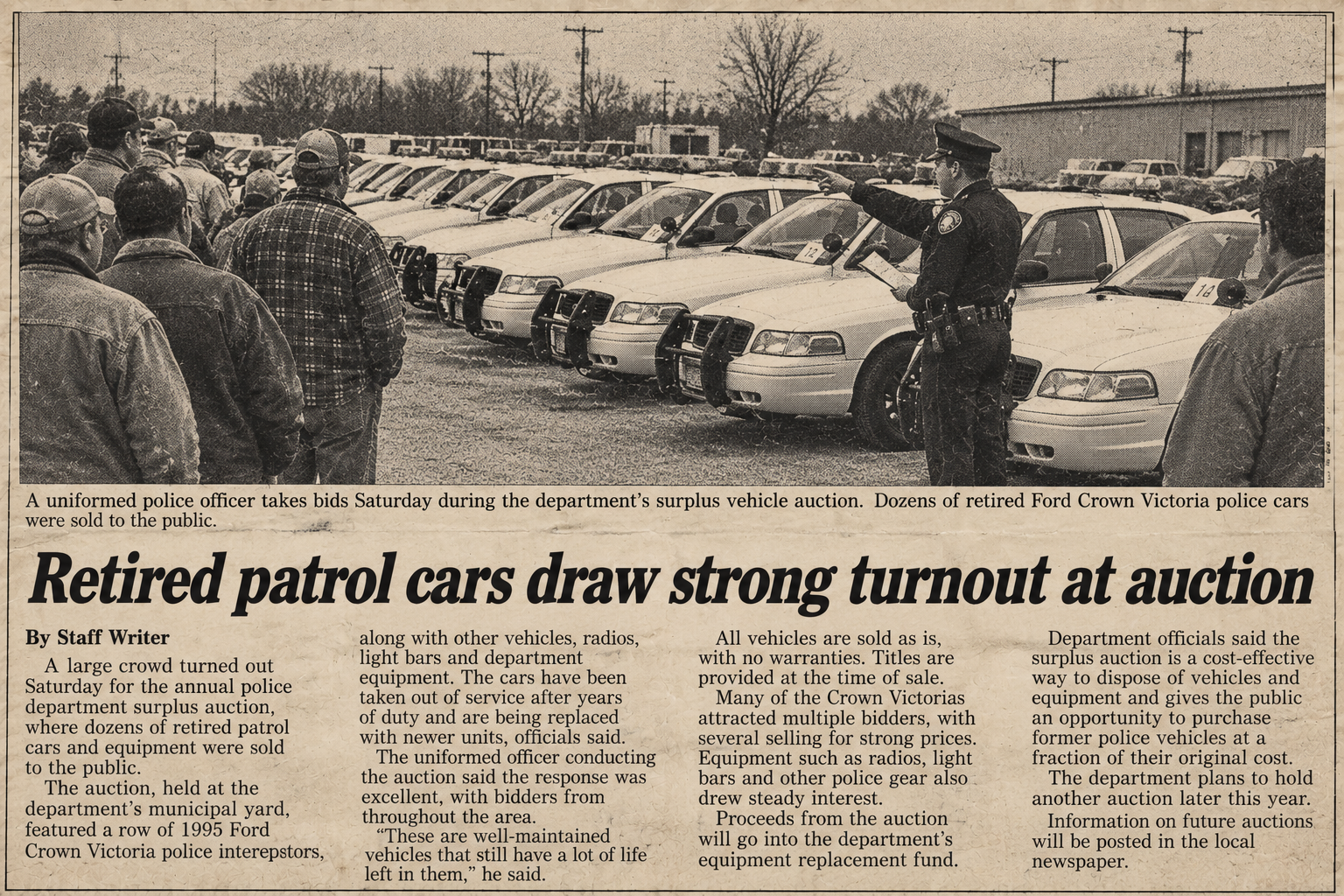
Illustration of a typical pre-Internet police surplus vehicle auction, when buyers gathered in person to inspect and bid on retired patrol cars.
Government auctions attracted every type of buyer: dealers, mechanics, business owners, bargain hunters and ordinary people looking for transportation. Police-car auctions drew especially memorable crowds—dealers who had purchased hundreds of Crown Victorias, taxi operators looking for durable fleet cars, mechanics looking for something cheap to repair, young buyers who wanted a former police car simply because it had been one, and people fascinated by spotlights, antennas, push bumpers and leftover equipment. Attend enough auctions and familiar faces appeared. People learned who bought what, who liked police cars, who bought trucks, who kept bidding, and who could turn a cheap car into an expensive one simply because he had decided he was going home with it. There were no anonymous usernames. The competing bidder wasn’t a number on a screen. He was standing ten feet away.
Then the Internet arrived. A small police department could suddenly show its vehicles to buyers hundreds or thousands of miles away. Photographs could be posted. Descriptions published. Bidding could last days instead of minutes. The geographic walls around local auctions began to disappear. Traditional auction companies built online platforms. New Internet-only services emerged. Government agencies experimented with different systems. Federal, state and local inventory increasingly became accessible through computer screens. The old Saturday auction didn’t vanish overnight, but the business was changing.
The Internet solved one problem—finding the auction—and created another. Government surplus became scattered across numerous websites and systems. One municipality used one platform, the neighboring county used another, a state agency used something else, and federal property was somewhere entirely different. The buyer no longer needed to search newspapers or listen for radio ads. Now he needed to know which websites to search. Information had reversed itself: before the Internet, auctions were hard to find because information was scarce; in the online era, auctions were hard to follow because information was abundant and fragmented.
Something was gained when auctions moved online. The market became vastly more accessible. A buyer no longer needed to live near the agency conducting the sale. Government property reached a larger audience. Buyers discovered vehicles and equipment they never would have known existed. But something disappeared too—the Saturday morning crowd behind the police station, the dealers carrying newspapers and auction lists, the inspection days, the familiar faces, the buyer quietly watching which car the dealer inspected, the unwritten rules, the questionable tricks, the strange characters, and the unfortunate buyer wondering why his pink dots suddenly pointed to all the wrong cars.
Government auctions were never secret. Agencies advertised them because they wanted participation. But in the old business, knowing where to look, knowing what to look at and knowing what something was worth were valuable pieces of information. Technology changed how government property is advertised, how bidders participate, how far an auction can reach and even who stands beside whom when the bidding begins. One thing hasn’t changed: enormous amounts of government property are still being sold across America. And whether the auction is behind a police station or on a computer screen, the first challenge remains the same:
YOU HAVE TO FIND IT.
UX Auctions