

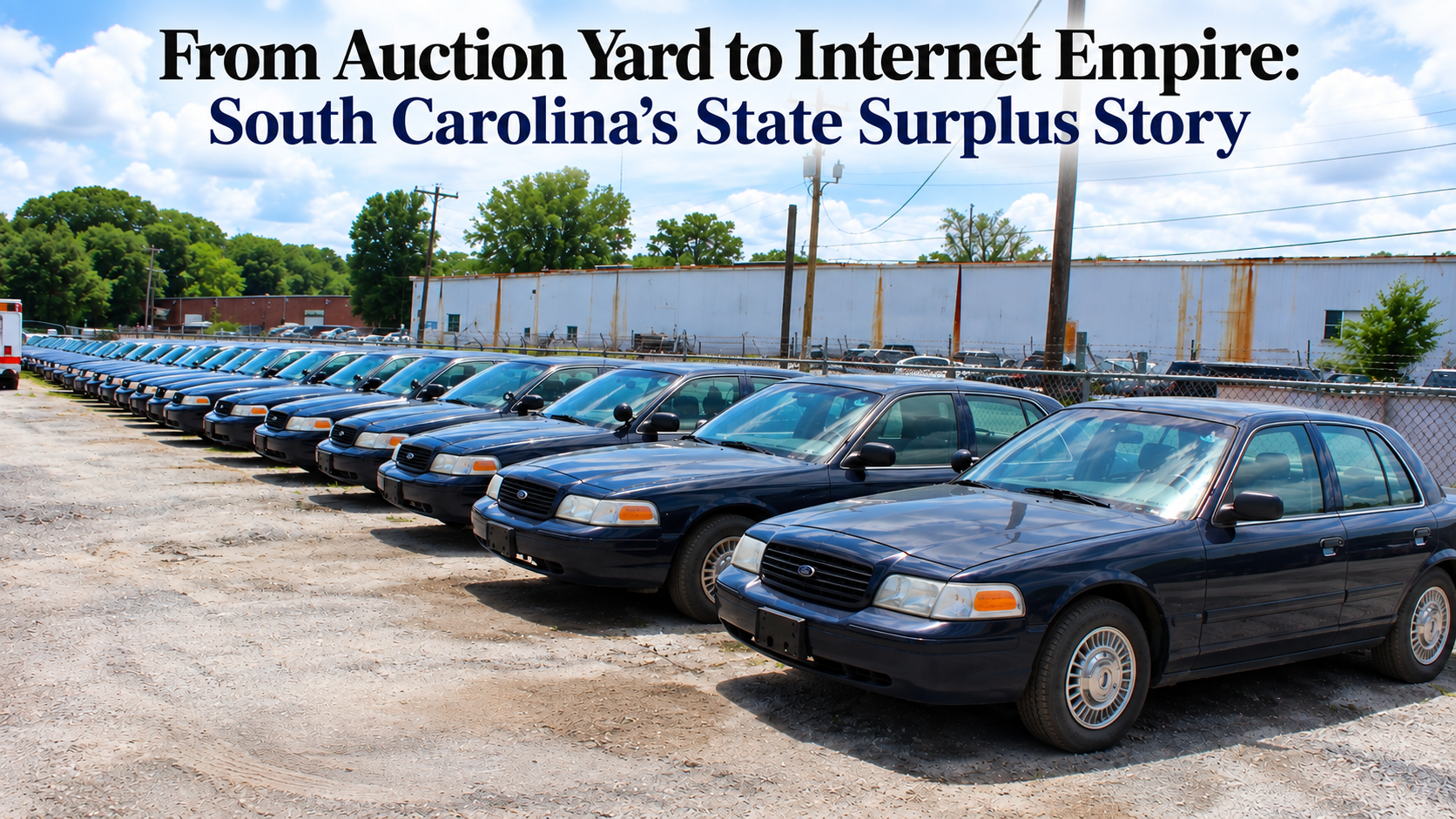

From Auction Yard to Internet Empire: South Carolina’s State Surplus Story
For more than seven decades, South Carolina has moved government vehicles, equipment and surplus property back into public use or into the hands of new owners—from live auctions at Boston Avenue to a multimillion-dollar online marketplace.
UX AuctionsLong before GovDeals turned government castoffs into an online marketplace, South Carolina was already recycling public property on an industrial scale. State archives contain records from an Office of Surplus Property Procurement dating to 1954, including monthly reports, correspondence and files tracking federal equipment distributed from the Savannah River Project. The program is not a recent experiment or merely an old parking-lot auction; it has been operating in some form for more than seven decades.
Today, the Surplus Property Office is part of the South Carolina Department of Administration and operates from 1441 Boston Avenue in West Columbia. State agencies generally must report property within 180 days after it becomes surplus, and the office records its source, description, quantity and original cost. Almost anything can pass through the system: cars, boats, tractors, golf carts, computers, furniture, cameras, kitchen equipment and athletic gear. The purpose is simple—keep useful equipment in public service when possible and turn the rest into money instead of letting it gather dust in dozens of agency warehouses.
The public does not necessarily get the first shot. State and local government bodies have priority, followed by eligible nonprofit organizations, before remaining property is offered for public sale. Vehicles historically received a two-week purchasing period for state agencies, with prices based largely on NADA loan values, recent sales and consultation with the agency surrendering the vehicle. Once those opportunities were exhausted, the public auction began.
For years, that meant showing up at Boston Avenue every other Wednesday. The sale appeared in The State newspaper on Sunday, prospective buyers inspected vehicles on Tuesday, and registration opened in the Operations Building on auction morning. There was no registration charge and, notably, no buyer’s premium. An auctioneer worked the crowd while retired cruisers, pickups, vans and other state machinery rolled across the block.
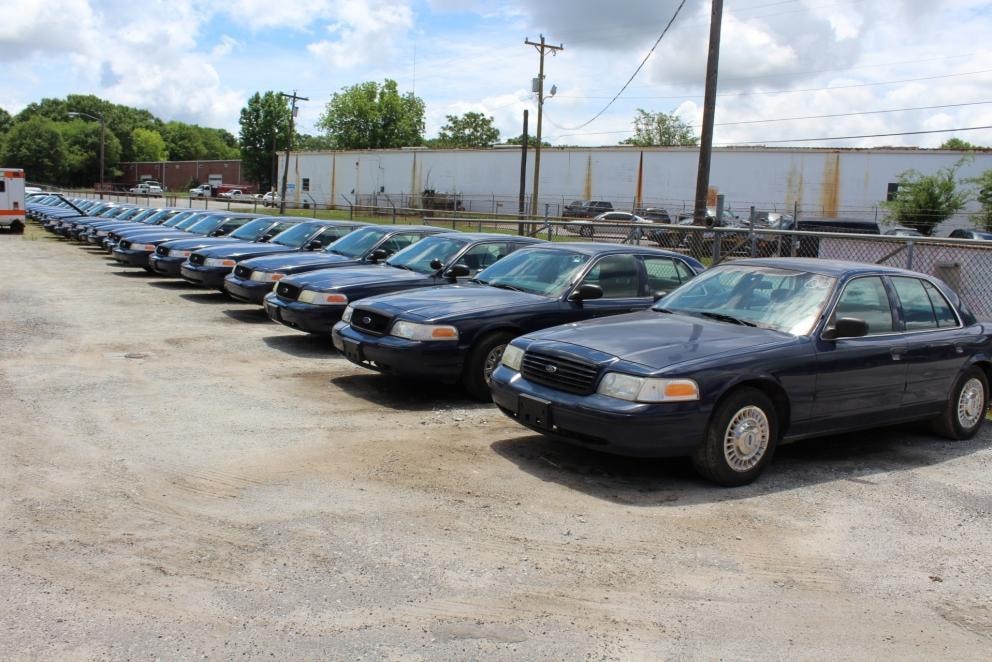
Rows of retired government fleet sedans at South Carolina State Surplus in West Columbia.
Those sales supported a much larger operation than most bidders probably realized. The office pays its expenses through service charges retained from surplus transactions. After those costs are deducted, proceeds generally go to the State General Fund, although certain agencies can receive approval to keep money for replacement property or other authorized purposes. State Fleet Management, for example, has historically retained vehicle proceeds for fleet replacement, while the Department of Natural Resources records income from surplus vehicle sales for law-enforcement operations. In other words, the winning bid does not simply become spending money for the Surplus Property Office.
South Carolina also runs a federal surplus program capable of obtaining vehicles, heavy machinery, rescue equipment, boats, furniture and even aircraft. Eligible recipients include government agencies, schools, universities and qualifying nonprofits. State employees can search federal installations for useful equipment and request property from overseas military facilities, then bring it to the West Columbia warehouse for distribution. Former GSA vehicles—often only three to five years old—are available to eligible public organizations, although those particular vehicles are not sold to the general public through the program.
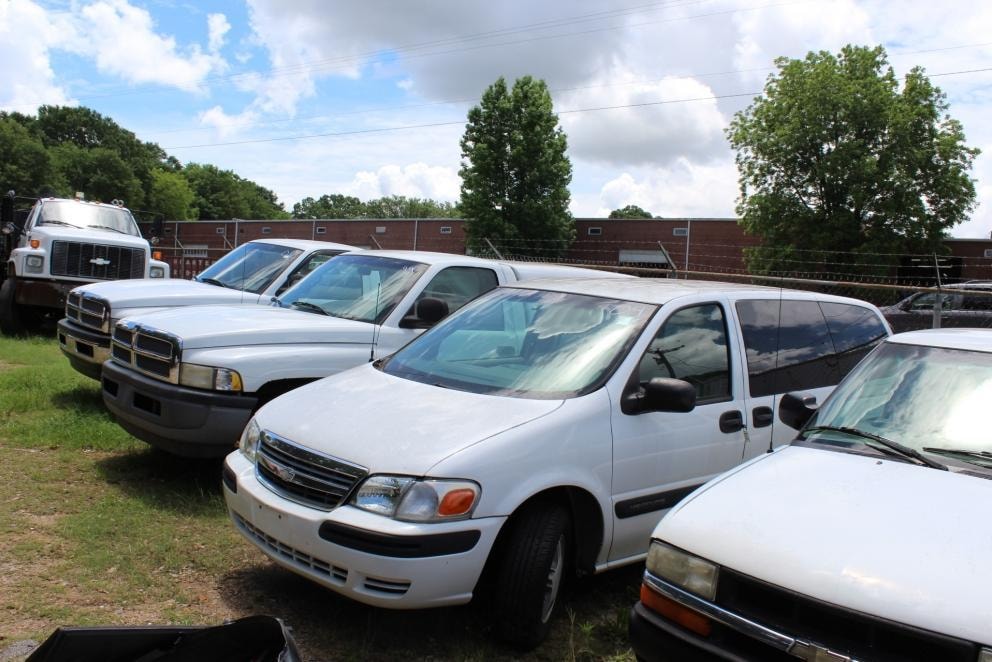
Trucks, vans and other government vehicles awaiting their next use through South Carolina’s surplus system.
Occasionally, the inventory becomes stranger than used patrol cars and filing cabinets. In 2011, South Carolina received 11,700 pounds of property surrendered at airport security checkpoints and sold it for more than $89,000. That meant the Boston Avenue operation processed nearly six tons of pocketknives, tools and other surrendered objects in a single year. The proceeds helped cover the cost of collecting and handling the material.
By 2012, the transition to Internet selling was unmistakable. Then-director Tom Hornsby was already discussing sales through eBay and GovDeals, giving buyers far beyond West Columbia access to state property. The scale became clear in fiscal 2023, when the State of South Carolina generated $13.4 million in GovDeals gross merchandise volume. That placed it third on the company’s disclosed list of its ten largest public-agency clients, behind Louisiana State Surplus at $19.9 million and the U.S. Postal Service at $14.8 million.
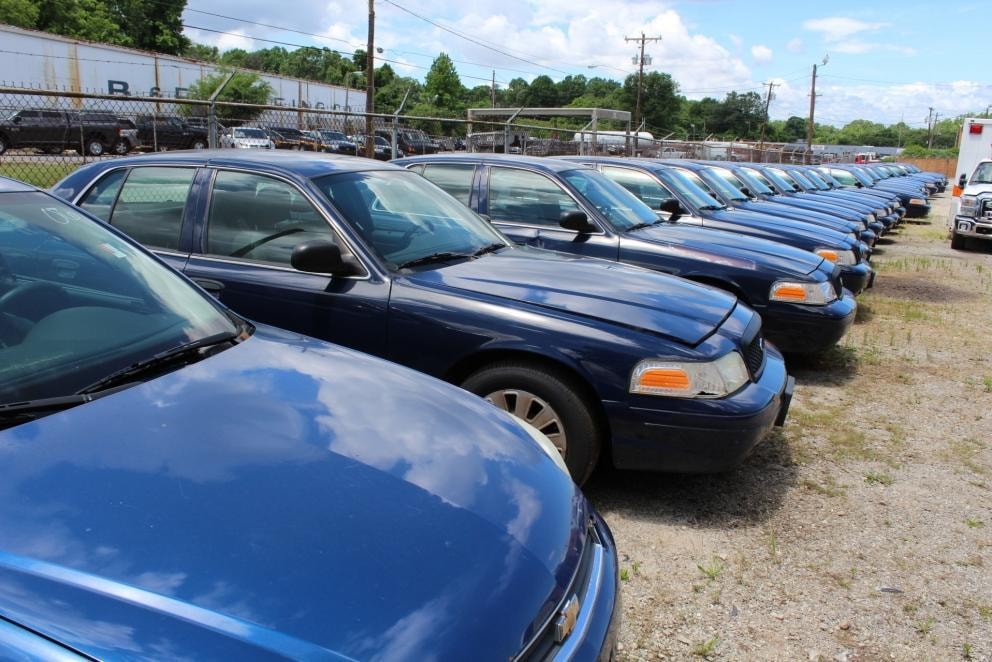
Retired fleet sedans lined up at the South Carolina surplus vehicle lot—the physical inventory behind an increasingly digital auction system.
That $13.4 million should not be mistaken for the program’s total annual revenue. It represents merchandise sold through one online channel and may exclude warehouse transactions, intergovernmental transfers, federal surplus distributions, sealed bids and other disposal methods. No reliable statewide figure has yet surfaced for the number of vehicles sold annually, so claims of a precise vehicle total would be speculation. What the figure does prove is that South Carolina’s online surplus trade alone is a major business.
The move online also changed the experience for buyers. Traditional Boston Avenue auctions charged no buyer’s premium, while recent State of South Carolina vehicle listings on GovDeals have added a 7.5 percent administrative fee to the winning price. Listings frequently warn that the Surplus Property Office receives limited information about vehicle condition, placing the burden on bidders to inspect before buying. The vehicles may still sit at Boston Avenue, but the crowd, auctioneer and Wednesday-morning competition have largely been replaced by screens and countdown clocks.
The old auction yard is quiet for now, with the state announcing that in-person public auctions are cancelled until further notice. Boston Avenue remains open, vehicles continue to enter the disposal system, and online bidding keeps the machinery moving. With a fiscal 2025–26 budget of approximately $3.3 million and 27 classified positions, this is clearly more than somebody selling old cars from a government parking lot.
It is a statewide property-recycling operation that grew from 1950s surplus distribution into a multimillion-dollar digital marketplace.
UX Auctions