


White or Milky Oil on a 2013–2019 Ford Police Interceptor Utility
What Auction Buyers Need to Know About the 3.7L and 3.5L V6
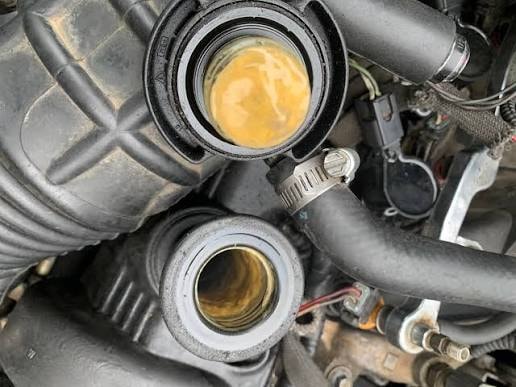
Milky or discolored fluid at engine coolant ports can indicate contamination — but the appearance alone does not establish the cause or extent of any damage.
White, tan, creamy, or milky oil on a 2013–2019 Ford Police Interceptor Utility (FPIU) indicates coolant contamination inside the engine. These Ford 3.7L and 3.5L V6 engines use an internal, timing-chain-driven water pump. When coolant enters the crankcase, the oil changes appearance immediately, even if the engine still idles smoothly during a short test.
FPIUs accumulate high engine hours that are not reflected by the odometer. Extended idle time, repeated heat cycles, and heavy operational use accelerate wear on timing components, gaskets, and the internal water pump.
Milky oil on these engines commonly results from coolant intrusion. Documented causes include internal water-pump failure, head-gasket breach, cracked cylinder heads, cracked blocks, or overheating events that weakened internal passages. These are major internal failures that directly affect the condition and value of the engine.
Coolant reservoirs showing discoloration, sludge, or oil streaking often indicate overheating or long-term contamination. Overheating accelerates timing-chain slack and can warp heads or damage internal components. Misfires — even if the engine sounds normal during a brief idle test — can indicate coolant entering a combustion chamber. Misfire activity combined with milky oil is a strong indicator of internal mechanical failure.
Code Readers vs. Professional Diagnostic Systems
A basic handheld code reader cannot diagnose these engines. It only displays simple stored trouble codes. It cannot access:
- Live misfire counts
- Timing correlation data
- Overheat history
- Cylinder contribution
- Freeze-frame evidence
- Cooling-system behavior
- Manufacturer-specific diagnostic parameters
Professional diagnostic systems — such as AllData, Ford IDS, Forscan with full module access, or advanced scan-tool platforms — provide the deeper data required to confirm internal coolant intrusion. These systems can read manufacturer-specific PIDs, timing data, misfire indexes, temperature events, and other evidence that a basic code reader cannot access.
The difference is factual: a basic code reader may show "no codes," while a professional diagnostic system can reveal a failing engine.
Internal Water Pump Design
Both the 3.7L and 3.5L V6 use an internal water pump driven by the timing chain. When the pump fails, coolant can leak directly into the crankcase. Once coolant mixes with oil, lubrication breaks down and internal damage begins immediately. Milky oil does not automatically confirm pump failure, but pump failure is one of the most common causes on these engines and must be considered.
Mechanical Impact
Coolant intrusion affects bearings, timing components, lubrication quality, and overall engine integrity. The condition of the oil, coolant, timing chain, and misfire data collectively determine the engine's true mechanical state.
Bottom Line
Milky oil on a 2013–2019 Ford Police Interceptor Utility is a significant mechanical indicator. Coolant intrusion, overheating history, timing-chain slack, misfires, and internal water-pump failure are all realistic possibilities. Code readers cannot diagnose these conditions; professional diagnostic systems can. The presence of milky oil should be treated as evidence of internal contamination and evaluated accordingly.
Milky oil is the warning. The failure is already in motion.
UX Auctions Magazine