
Government Contracts
The Government Spent $7.4 Billion on Security Guards Last Year. Here's How to Get Your Share as a Small Business.
The federal government spends more on security guards than on almost any other service a small business can sell it. In fiscal year 2026, agencies obligated $7.39 billion for security guards and patrol services, NAICS 561612, across 6,924 awards, according to USAspending.gov. The Department of Homeland Security alone accounted for $4.66 billion of that, most of it through the Federal Protective Service, which staffs federal buildings with contract guards. The State Department spent $882 million guarding embassies and missions, the Justice Department $775 million, the Defense Department $398 million and Health and Human Services $127 million. Those agencies buy the same service every year, and a large share of it is reserved for small businesses.
On October 26, 2026, there were fourteen security guard solicitations open on SAM.gov, ten of them set aside for small businesses, and ten due within the next two weeks. The whole list, with deadlines and set-asides, is on the security guard services page at UX Contract, and it updates twice a day.
Who is buying guards this week
The Department of Veterans Affairs is the busiest buyer on the list. It wants a security guard for its community clinic in Fairbanks, Alaska, with bids due October 28, unarmed guards for the Southeast Louisiana Veterans Health Care System in New Orleans on a one-year contract with four option years, and security staffing for a North Campus facility running from May 2027 through 2028. All three are set aside for service-disabled veteran-owned small businesses, which is the VA's standing preference and the single biggest advantage a veteran who owns a security company has in this market.
Homeland Security is looking ahead to armed protective security at the IRS campus in Austin, Texas, is taking bids on guard services for FEMA's Region 4 office in Lake Mary, Florida, under a total small business set-aside, and is buying protective security officer services across the Los Angeles area with no set-aside at all, which means any qualified company can bid. The Department of Transportation needs armed guards at the William J. Hughes Technical Center near Atlantic City under an 8(a) set-aside. The Interior Department is surveying the market for security at Davis and Parker Dams on the Colorado River. The State Department is sizing up cleared American guards and construction surveillance technicians for embassy work, and it is about to post local guard services for the U.S. Mission in Guatemala City. Army Intelligence and Security Command wants access control and security escorts under another 8(a) set-aside.
Each of those notices links to its official page on SAM.gov from the UX Contract listing, and the ones marked sources sought are the best opening for a new company: the agency is asking who can do the work before it writes the solicitation, and a capability statement sent at that stage can shape whether the final bid is set aside and for whom.
The vehicles a guard contract runs on
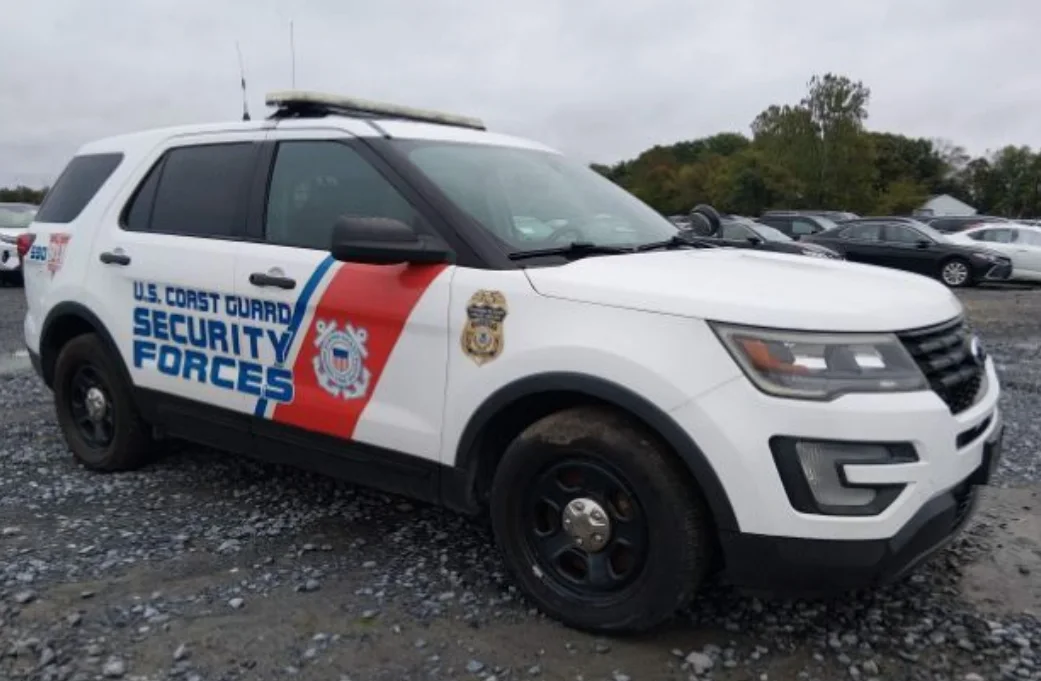
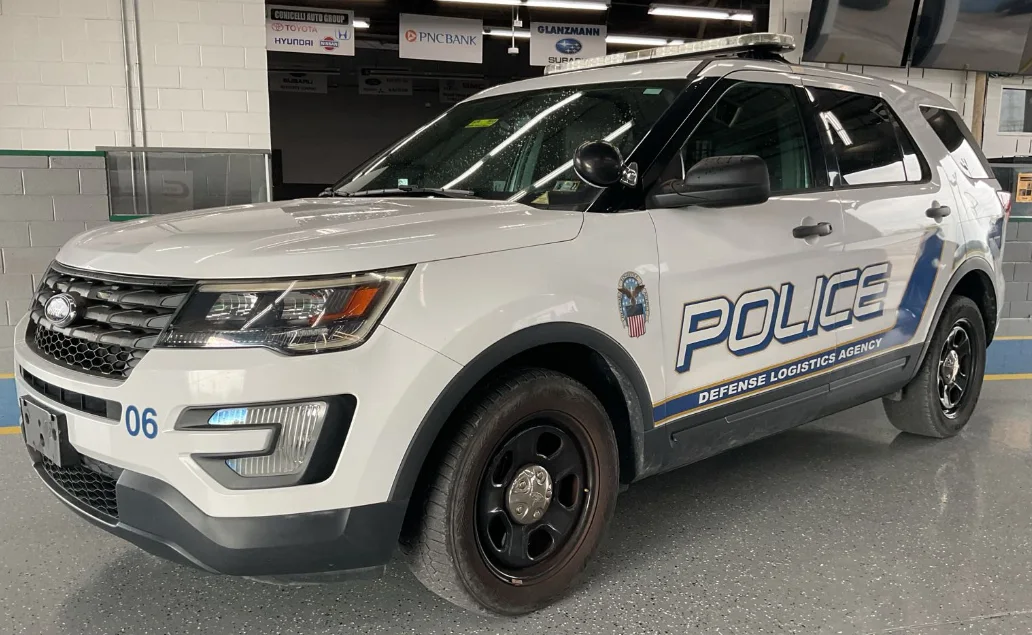
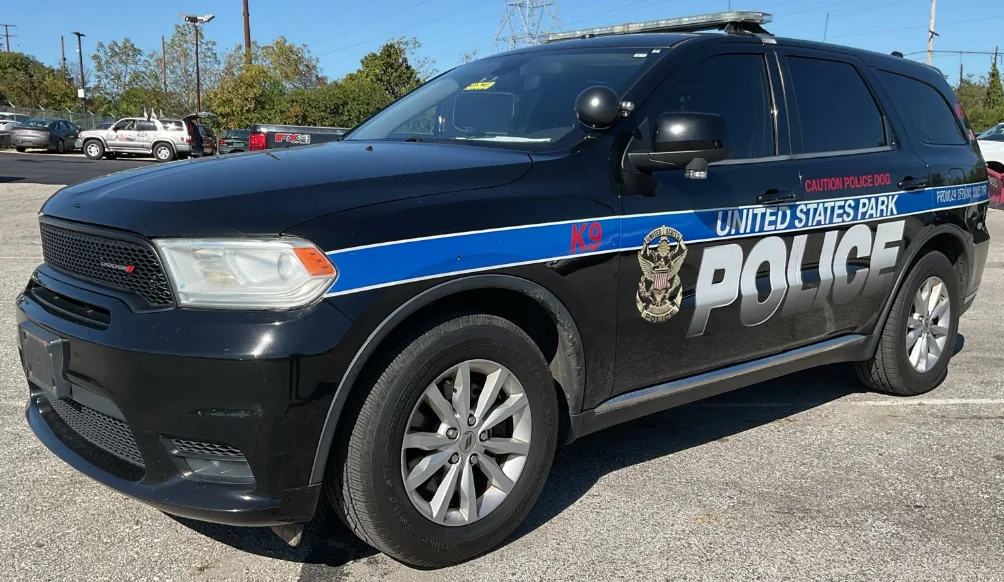
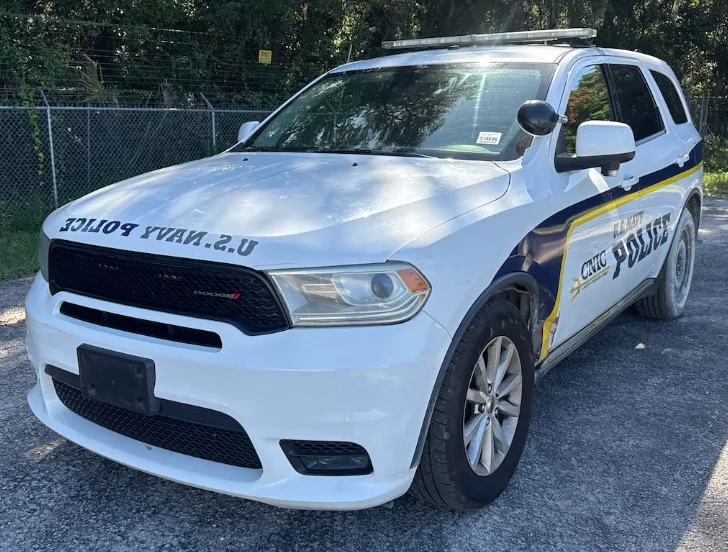
A security contract with any ground to cover needs patrol vehicles, and the vehicles the federal government itself retires are the best-suited ones on the market. The four in these photos were all working federal police units until recently: a Ford Police Interceptor Utility from the Coast Guard's security forces, a Ford Interceptor Utility from the Defense Logistics Agency police, a Dodge Durango Pursuit from the U.S. Park Police with its K9 markings still on, and a Durango from the Navy's installation police. Every one of them carries the pursuit package that a civilian Explorer or Durango does not: heavier cooling, bigger brakes, a high-output alternator, a stiffer suspension and, in the Ford's case, all-wheel drive tuned for the job.
UX Search finds every government auction platform at once, so a search for a police interceptor pulls in GSA Auctions, GovPlanet, GovDeals, Public Surplus and the state surplus sites together, sorted by closing time. The listing page for each truck shows the similar ones that already sold, and the Price Report shows the real hammer prices by month, so a security company can put a number on its fleet before it prices a bid.
The line a security company is not in
The question we hear most from security contractors is whether a licensed company can get these vehicles before the public does, or get them fully outfitted. The rules answer both, and the answer to both is no.
Every federal vehicle goes through the same line before it reaches an auction. Under GSA's disposal process, excess property is offered first to other federal agencies, along with their contractors and grantees and the District of Columbia government. Whatever they do not take is declared surplus and offered for donation through each state's surplus property agency to state and local public agencies, schools, public health nonprofits and public airports. Only what is left after that goes to public sale on GSA Auctions. A county sheriff's office can pick up a Coast Guard Explorer or a Park Police Durango at the donation stage for little more than shipping. A private security company, however licensed, is not on the list at any stage before the public sale.
Military vehicles like the DLA and Navy police units go through the Defense side, where the order is the same and the priority is even clearer. DLA Disposition Services offers them to law enforcement first under the 1033 program, which is open only to a government agency whose primary function is enforcing the law, with sworn officers who have arrest powers. The agency pays shipping and nothing else. What law enforcement passes on goes to public sale, which for Defense property runs through GovPlanet.
As for fully outfitted, the public sale gets the decommissioned truck. Fleets pull the light bars, sirens, radios, computers, cages and push bumpers before a vehicle goes up and either reuse the parts or sell them separately. Federal units reach the auction block with their markings on more often than city units do, as the four in these photos show, but the buyer is expected to remove them, and state law decides what happens to the lights. Most states make it illegal for a private vehicle to display or use red or blue emergency lights, and some restrict who may buy them. Body armor and other protective gear is not sold to the public at all.
What changes when you win the contract
Winning a federal guard contract does not put the company in the screening line. It puts the contracting officer in it on the company's behalf, and the rules lean against using that.
A contractor never acquires excess property on its own. The agency that holds the contract can pull excess property from the federal system for use by its contractors, but only under the Federal Acquisition Regulation's rules on government property, and when the contract ends the agency takes it back and disposes of it through the normal process. A vehicle obtained that way is government-furnished property: the government keeps the title, the contractor uses it on that contract only, accounts for it, and returns it when the work ends.
The regulation's starting point is that contractors are ordinarily required to furnish all property necessary to perform government contracts. A contracting officer can furnish property only after showing it is clearly in the government's interest, that the benefit outweighs the extra administration and disposal cost, that it does not raise the government's risk and that the need cannot be met another way, and the rule says plainly that a contractor's lack of resources, or its preference not to buy its own, is not a reason. For a guard contract, where any sound SUV or pickup does the job, that case is hard to make, which is why guard solicitations are written with the contractor supplying its own vehicles.
Government-furnished vehicles do show up where the government wants its own marked units on the job, such as contract guards at a federal facility driving agency-marked patrol vehicles, or where the equipment is specialized. When that is the case the solicitation says so, in a section listing government-furnished property, and the price is expected to be lower because of it. That section is worth reading in every guard solicitation, and whether vehicles will be furnished is a fair question to ask the contracting officer during the question period.
The practical answer
Read each solicitation for a government-furnished property clause. If it has one, the vehicles come with the job and go back when it ends. If it does not, which is most of them, the company buys at the public auction after the agencies have screened, and the Interceptor or Durango it brings home is its own to keep, strip of markings and run on the next contract too. For a company building a fleet, owning the vehicles is the stronger position anyway, and buying them where the government sells its own is the lowest cost of entry there is.
The path from a vehicle to a contract is the same one every federal contractor walks, and UX Contract covers each step in plain English. Registration in SAM.gov is free and takes a few weeks, so it comes first; the SAM registration guide explains the Unique Entity ID and the CAGE code. The set-asides guide explains why ten of the fourteen open guard bids are limited to small, veteran-owned or 8(a) businesses and how to tell which ones a company qualifies for. The bid checklist and the pricing worksheet turn a guard solicitation into a number, with the officers, the hours, the vehicles and the insurance all accounted for, and UX Contract's awards search shows who holds the current contracts and what they were paid, which is the clearest picture of the going rate a new bidder can get.
The UX Network connects these pages to each other. The security guard page on UX Contract shows the Interceptors and Durangos closing soonest at government auction, with photos. A police vehicle listing on UX Search shows the guard bids due this week. This article shows both, and all of it is free. Members who want to track the bids and the auctions together, with deadline and closing alerts, can do that in UX Console; everything else is open to everyone.
Ford Explorer at government auction, closing soonest
All ford explorer auctions →Live now on UX Search, from the agencies that sell their surplus. Updated every hour.
 2018 Ford Explorer 4WD Police Interceptor SUV (ID# 48321) (W32) (26-3200) 225$1,724.9 · Tumwater, WA
closes in 1 hour · GovDeals
 2017 Ford Explorer$6,000 · Wanaque, NJ
closes in 11 hours · GovDeals
 2013 Ford Explorer$6,000 · Wanaque, NJ
closes in 11 hours · GovDeals
 2016 Ford Explorer$600 · Pell City, AL
closes in 13 hours · GovDeals
 2016 Ford Explorer$535 · Highland Park, NJ
closes in 14 hours · GovDeals
 2022 Ford Explorer 4 WD SUV - Surplus Lot$2,525 · Nashville, TN
closes in 15 hours · GovDeals
Government bids for security guard services, due soonest
All 4 →Open federal bids from SAM.gov on UX Contract, free to search. 2 due this week.
© 2026 UX™ LLC. All Rights Reserved.