
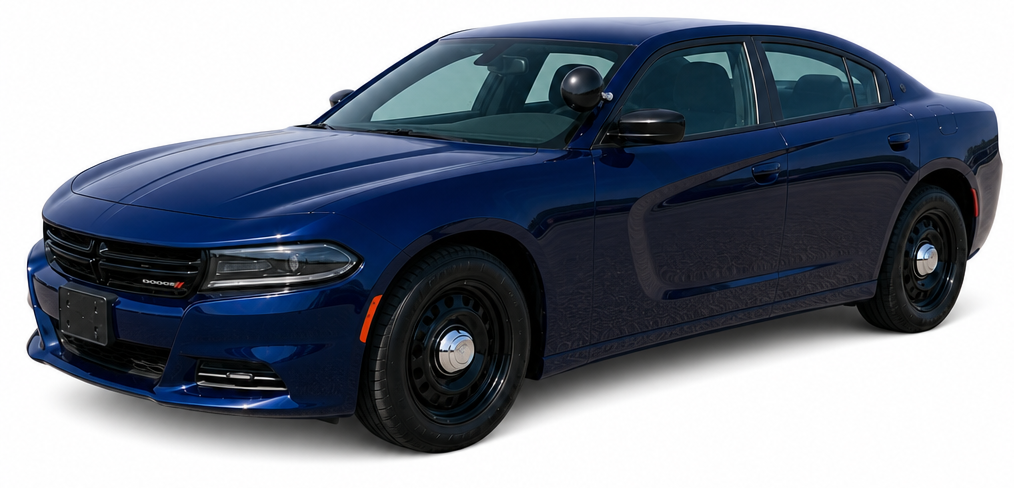
Dodge Charger Pursuit Research
Understanding the Dodge Charger Pursuit Before You Buy
Buying a Retired Dodge Charger Police Vehicle: What Every Buyer Should Know
The Dodge Charger Pursuit has been one of the most recognizable law enforcement vehicles in North America since its introduction for the 2006 model year. Designed specifically for police service, the Charger Pursuit combines rear-wheel-drive performance, available all-wheel drive on select models, heavy-duty cooling systems, upgraded suspension, and police-specific electronics to withstand the demands of patrol work and emergency response.
Today, retired Dodge Charger police vehicles are among the most common vehicles sold through government auctions. They can represent excellent value, but buyers should understand that these cars were built for severe-duty operation and often experience far more wear than the odometer suggests.
What Makes the Charger Pursuit Different?
Although it shares its platform with civilian Dodge Chargers, the Pursuit model includes numerous upgrades designed for law enforcement.
Police-package equipment typically includes:
Heavy-duty cooling systems
High-capacity alternator and charging system
Police-calibrated suspension
Heavy-duty brakes
Certified speedometer
Engine and transmission calibrations designed for pursuit duty
Reinforced electrical systems for emergency equipment
Larger engine oil and transmission cooling capacity
Equipment varies depending on model year and agency specifications.
Available Engines
3.5L High Output V6 (2006–2010)
Early Charger Pursuit models were available with the 3.5-liter High Output V6.
While generally dependable, most agencies preferred the available HEMI V8 for patrol use because of its significantly greater performance.
Common inspection points include:
Cooling system condition
Oil leaks
Ignition components
Timing belt maintenance history
Transmission operation
Vehicles equipped with the 3.5L use a timing belt that requires periodic replacement according to manufacturer service intervals.
5.7L HEMI V8 (2006–2023)
The 5.7-liter HEMI V8 has been the backbone of the Charger Pursuit lineup for most of its production.
It delivers strong acceleration, excellent highway performance, and proven durability when maintained properly.
Common inspection points include:
Exhaust manifold bolt failures
Water pump leaks
Cooling system maintenance
Ignition coil condition
Oil leaks
Unlike civilian Chargers equipped with the Multi-Displacement System (MDS), many police-spec 5.7L Pursuit engines were calibrated without cylinder-deactivation, reducing one potential maintenance concern. Buyers should verify the specifications of the individual vehicle, as equipment and calibrations can vary by model year.
3.6L Pentastar V6 (2012–2023)
Beginning with the redesigned Charger, many agencies selected the 3.6-liter Pentastar V6.
The Pentastar has earned a solid reputation for reliability and lower operating costs while still providing adequate performance for many police applications.
Areas to inspect include:
Oil filter housing and oil cooler assembly for leaks
Cooling system condition
Spark plug maintenance
Accessory drive components
The oil cooler and filter housing assembly, located in the engine valley, is one of the most commonly reported maintenance items on higher-mileage Pentastar engines.
Transmission
Five-Speed Automatic (2006–2014)
Earlier Charger Pursuit models used a five-speed automatic transmission that is generally considered durable when serviced properly.
Inspect for:
Smooth shifting
Delayed engagement
Fluid leaks
Harsh gear changes
Eight-Speed Automatic (2015–2023)
Beginning with the refreshed Charger, most Pursuit models received the ZF-designed eight-speed automatic transmission.
The eight-speed is widely regarded as one of the best automatic transmissions offered in a modern police vehicle, providing quick shifts, improved fuel economy, and excellent durability.
As with any transmission, regular fluid service and proper maintenance contribute significantly to long-term reliability.
Rear-Wheel Drive and All-Wheel Drive
Most Charger Pursuit vehicles are rear-wheel drive.
Certain model years were also available with all-wheel drive, particularly when equipped with the Pentastar V6.
When inspecting AWD models, examine:
Front axle components
Transfer case
Driveshaft
Differential operation
Evidence of fluid leaks
Police Use and Idle Hours
Retired Charger Pursuit vehicles frequently accumulate thousands of idle hours while displaying relatively moderate mileage.
Patrol cars often spend extended periods:
Idling during traffic enforcement
Running emergency lighting
Operating communications equipment
Waiting at accident scenes
Conducting surveillance
High idle hours increase wear on engine components, cooling systems, alternators, air-conditioning compressors, and other accessories.
Whenever possible, obtain engine-hour information in addition to mileage.
Common Inspection Points
Regardless of engine choice, inspect:
Cooling system
Transmission operation
Suspension components
Brake condition
Wheel bearings
Steering system
Oil leaks
Electrical wiring removed during decommissioning
Holes drilled for emergency equipment
Battery and charging system
Rust and underbody condition
Many retired patrol cars have had radios, computers, center consoles, prisoner partitions, and emergency lighting removed before auction. Carefully inspect any remaining wiring to ensure modifications were completed properly.
Interior Wear
The driver's seat typically experiences the greatest wear due to officers entering and exiting the vehicle while carrying duty belts and equipment.
Inspect:
Seat upholstery
Seat frame movement
Steering wheel wear
Dashboard mounting holes
Center console modifications
Carpet condition
Cosmetic wear is common and generally does not affect mechanical reliability.
Should You Buy One?
The Dodge Charger Pursuit remains one of the best-performing retired police vehicles available on the used market.
Its strong chassis, proven HEMI V8, capable Pentastar V6, and purpose-built police engineering make it a popular choice among enthusiasts, commuters, and government auction buyers.
Rather than focusing solely on mileage, buyers should prioritize maintenance records, engine hours, transmission performance, cooling system condition, and the overall mechanical health of the vehicle.
A well-maintained Charger Pursuit can provide many additional years of dependable service while offering performance and durability that few civilian sedans can match at a comparable purchase price.
As with any retired fleet vehicle, purchasing the best-maintained example is far more important than simply choosing the lowest-mileage one.
Reference Documentation
Important Bulletin Applicability Notice
Technical Service Bulletins are not recalls and do not establish that every listed vehicle has the condition described. A bulletin may apply only to vehicles with specific engines, transmissions, sales codes, production dates, software versions, markets, or symptoms.
Before relying on a bulletin, verify:
Vehicle identification number
Model year
Production date
Engine sales code
Transmission sales code
Drivetrain configuration
Police Pursuit designation
Diagnostic trouble codes
Whether the bulletin was revised or superseded
Some Dodge Charger bulletins cover both civilian and police vehicles, while others apply only to particular Charger configurations.
Verified Manufacturer Technical Documentation
FCA Case S1809000007 Rev. C — Oil Filter Adapter/Cooler Leak Diagnosis
Release date: June 2021
System: 3.6L Pentastar engine lubrication system
Condition addressed: Engine-oil leakage or apparent oil consumption caused by oil accumulating in the engine valley around the oil filter adapter and cooler assembly.
The FCA STAR communication instructs technicians to inspect the oil filter adapter/cooler area, replace the adapter seals when appropriate, add leak-detection dye, run the engine, and confirm whether the adapter itself or its seals are responsible for the leak.
This document supports inspecting the 3.6L Pentastar oil filter housing and cooler assembly when oil is discovered in the engine valley. It is a STAR technical communication rather than a safety recall or automatic authorization for repair.
TSB 09-008-15 — 3.6L Oil Loss Diagnostic Aid
Publication date: August 7, 2015
Applicable Charger identified in bulletin: 2014 Dodge Charger, platform code LD
Engine: 3.6L V6, sales code ERB
Build limitation: Vehicles built on or before January 20, 2014
System: Engine lubrication
This bulletin addresses reports of oil loss, low oil, oil seepage, or oil consumption. It instructs technicians to inspect for oil pooling in the engine valley beneath the intake manifold and near the oil filter housing.
The bulletin notes that the engine valley can retain a substantial quantity of oil without producing an obvious external leak. If oil is pooling in this area, the oil filter housing may require replacement.
TSB 21-019-16 — Transmission-Control Software and Shift-Quality Updates
Publication date: June 17, 2016
Applicable Charger identified in bulletin: 2015 Dodge Charger, platform code LD
Engine: 3.6L V6, sales code ERB
Transmissions listed:
845RE eight-speed, sales code DFL
8HP45 eight-speed, sales code DFG
W5A580 five-speed, sales code DGJ
This bulletin calls for reprogramming the Transmission Control Module with updated software. Conditions addressed include improved shift quality, a harsh or noticeable 2–1 downshift, incorrect fourth-gear ratio faults, unintended out-of-park faults, and transmission-control monitoring faults.
The bulletin specifically states that applicability depends on the installed engine and transmission combination.
TSB 21-023-16 — Transmission Shift and Drivability Enhancements
Publication date: June 23, 2016
Applicable Charger identified in bulletin: 2016 Dodge Charger, platform code LD
Engine: 3.6L V6, sales code ERB
Transmissions: 845RE or 8HP45 eight-speed
Build limitation: Charger vehicles built on or before May 31, 2016
This bulletin addresses delayed or hanging upshifts after rapid acceleration, braking downhill, or quickly releasing the accelerator. The software update also provides shift-quality improvements for certain downshift conditions.
The repair procedure consists of reprogramming the Transmission Control Module with the latest available software.
TSB 21-041-17 — Transmission-Control Module Software Update
Publication date: September 12, 2017
Applicable Charger identified in bulletin: 2015 Dodge Charger, platform code LD
Engine: 3.6L V6, sales code ERB
Transmissions: 845RE or 8HP45 eight-speed
This bulletin addresses several transmission-related conditions, including:
Poor or harsh shift quality
Harsh 2–1 downshift or low-speed bump
Abnormally high shift points following certain software updates
Seventh and eighth gears becoming temporarily unavailable
Incorrect fourth-gear ratio fault
Park-by-wire and transmission-control processor faults
The prescribed repair is installation of updated Transmission Control Module software.
TSB 21-016-17 Rev. A — Coast-Down Shift Quality
Publication year: 2017
Applicable platform identified: LD Dodge Charger
System: Automatic transmission software
This bulletin addresses poor coast-down shift quality described as a bump during deceleration. It also includes revised transmission software addressing diagnostic and drivability conditions.
Applicability depends on the vehicle platform, powertrain, software level, and production configuration.
TSB 21-009-17 Rev. E — Transmission Shift and Drivability Updates
Publication year: 2017
Applicable platform identified: LD Dodge Charger
System: Automatic transmission and powertrain software
This revised bulletin includes software updates addressing poor coast-down shift quality and other transmission-control conditions. Some provisions are restricted by engine sales code and transmission configuration.
Because the bulletin was revised multiple times, technicians and buyers should consult the latest revision applicable to the individual VIN.
TSB 21-063-15, Later Revised as TSB 21-023-16
The earlier bulletin number 21-063-15 was superseded by the revised 21-023-16 publication. The revision expanded or clarified production dates, symptoms, procedures, and labor information.
This is an example of why bulletin numbers should be checked for later revisions before being cited as current service instructions.
Verified Recall and Service-Campaign Documentation
Safety Recall U37 / NHTSA Recall 18V-281 — Front Propeller Shaft
Affected configuration: Certain all-wheel-drive Dodge Chargers equipped with the 5.7L V8
Production period identified by manufacturer: August 5, 2014, through March 7, 2018
System: AWD front propeller shaft
The recall concerns the possibility of front propeller-shaft separation. A separated shaft could contact surrounding components and create additional vehicle damage or a loss-of-propulsion concern.
This recall is particularly relevant when inspecting an AWD, V8-powered former police Charger. VIN verification is required because not every AWD Charger is included.
Safety Recall S68 — Alternator
The S68 recall involved alternator replacement procedures on certain FCA vehicles, including affected Charger configurations. The manufacturer's repair instructions include different procedures for rear-wheel-drive and all-wheel-drive vehicles.
Recall applicability must be determined by VIN rather than model name alone.
Warranty Bulletin D-19-17 / X79 — 3.6L and 5.7L Fuel Pump
Vehicles identified: Certain 2011–2016 Dodge Charger Pursuit vehicles
Engines: 3.6L and 5.7L
Program type: FCA warranty and exchange-order program
FCA warranty documentation identifies a fuel-pump program specifically associated with 2011–2016 Dodge Charger Pursuit vehicles equipped with the 3.6L or 5.7L engine.
This documentation is relevant when reviewing previous fuel-pump replacement records, but it should not be treated as a universal safety recall covering every Charger Pursuit.
Police and Fleet Documentation
The following manufacturer documents should be consulted for the exact model year under consideration:
Dodge Charger Pursuit specifications
Dodge Charger Pursuit upfitter guide
Police electrical and wiring guide
Emergency-equipment installation instructions
Police vehicle owner's manual supplement
Dodge Charger factory service information
Mopar maintenance schedules
Applicable Stellantis Fleet technical publications
These documents identify factory circuits, equipment mounting limitations, alternator capacity, grounding provisions, auxiliary power connections, airbag zones, cooling equipment, police calibrations, and other features that may differ from civilian Charger models.
Independent Police-Vehicle Testing
Michigan State Police Vehicle Evaluation Program
Michigan State Police conducts annual evaluations of police vehicles and publishes results covering areas such as:
Acceleration
Braking
Top speed
Vehicle dynamics
Ergonomics
Fuel economy
Pursuit suitability
The reports are useful for confirming the tested performance and police configuration of specific Charger Pursuit model years. They do not determine the present mechanical condition of an individual retired vehicle.
Los Angeles County Sheriff's Department Vehicle Testing
The Los Angeles County Sheriff's Department has also conducted police-vehicle testing for applicable model years. These reports can provide additional performance, braking, handling, and fleet-use information.
Government Resources
National Highway Traffic Safety Administration recall database
NHTSA manufacturer communications and Technical Service Bulletin database
NHTSA Office of Defects Investigation
Michigan State Police police-vehicle test archives
Applicable state and municipal fleet-maintenance records
Recommended Documentation Review Before Purchase
Before purchasing a retired Dodge Charger Pursuit:
Run the VIN through the NHTSA recall database.
Confirm whether the vehicle is an authentic police-package Charger.
Identify the engine and transmission sales codes.
Obtain the original agency maintenance records when available.
Compare repair records with applicable TSBs and service campaigns.
Check whether software updates were completed.
Verify whether the oil filter housing or cooler has been replaced on 3.6L models.
Verify fuel-pump history on applicable 2011–2016 Pursuit vehicles.
Confirm completion of the U37 front-propeller-shaft recall on applicable AWD V8 vehicles.
Check the alternator recall status where applicable.
Review engine and idle hours in addition to mileage.
Inspect all remaining emergency-equipment wiring.
Have the vehicle scanned for stored, pending, and historical diagnostic trouble codes.
Conduct a road test with the transmission fully warmed.
Obtain an independent mechanical inspection.
Primary Reference Sources
FCA US LLC and Stellantis Technical Service Bulletins
FCA STAR technical communications
Dodge Charger Pursuit factory service information
Dodge Charger Pursuit upfitter documentation
Mopar service and maintenance publications
National Highway Traffic Safety Administration
Michigan State Police Precision Driving Unit
Los Angeles County Sheriff's Department vehicle-evaluation publications
This reference list is intentionally limited to documentation that can be identified and verified. It is not a complete list of every bulletin issued for every Dodge Charger model year. Bulletins should always be matched to the individual vehicle's VIN, build date, sales codes, drivetrain, symptoms, and installed software.
Continue Your Research
Buying a retired police vehicle is only the first step. Understanding the factory engineering, manufacturer updates, Technical Service Bulletins (TSBs), recalls, and police-specific documentation can help you make a more informed purchase and simplify future maintenance.
For readers who want a deeper technical understanding of the Dodge Charger Pursuit, UX Auctions has created a dedicated Dodge Charger Pursuit Reference Documentation library containing:
Official Dodge / Stellantis manufacturer publications
Factory Service Manual (FSM) references
Police Upfitter Guides
Technical Service Bulletins (TSBs)
Safety recalls and manufacturer communications
Police vehicle specifications
Fleet maintenance documentation
Wiring and electrical integration information
Michigan State Police vehicle evaluations
Los Angeles County Sheriff's Department testing
Maintenance schedules
Factory specifications
Buyer inspection checklists
Additional technical resources
Dodge Charger Pursuit Reference Documentation
Whether you're a first-time buyer, dealership, fleet manager, mechanic, or automotive enthusiast, the Dodge Charger Pursuit Reference Documentation is designed to serve as a continually updated technical resource, providing access to official manufacturer information and government documentation to help you research, inspect, maintain, and service retired Dodge Charger Pursuit vehicles with confidence.