


Inside the Tahoe’s 5.3L: What Auction Buyers Need to Know
GM has documented specific lifter and valvetrain conditions in the 5.3L Tahoe. Knowing which engine you’re inspecting gives you a much better place to start.
Auctions News Network Staff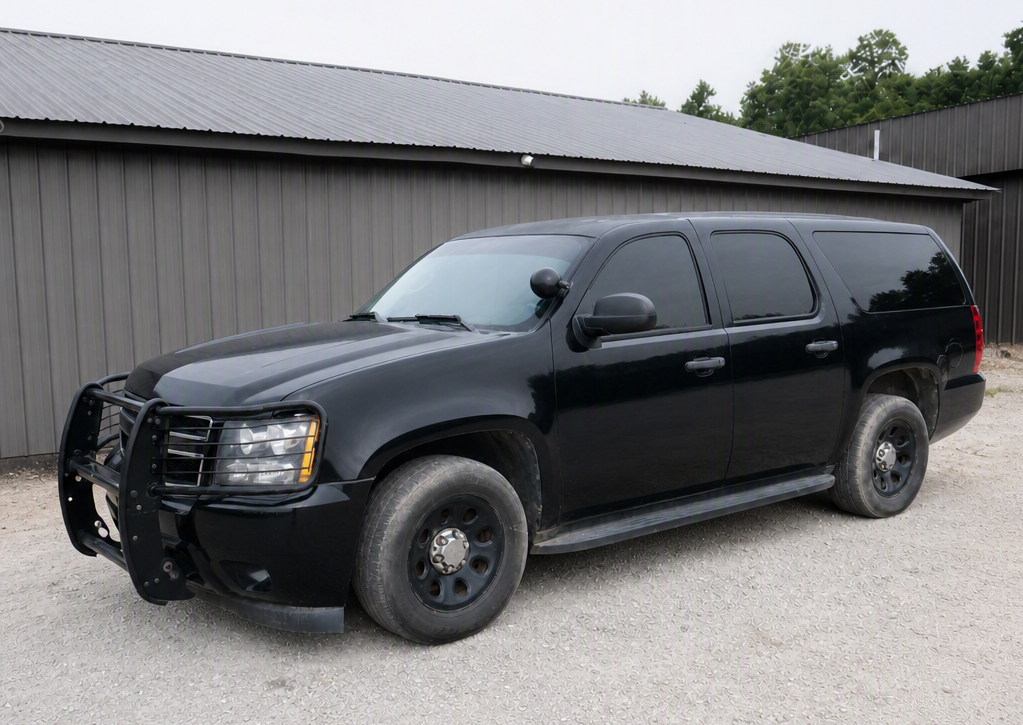
A black Chevrolet Tahoe PPV — the 5.3L V8 platform has been the subject of GM service information addressing lifter and valvetrain conditions across multiple model years.
The Chevrolet Tahoe has used the 5.3L V8 for years, but not every 5.3L Tahoe has the same engine or cylinder-deactivation system. For an auction buyer, the important distinction begins with the model year.
The 2015–2020 Chevrolet Tahoe uses the L83 5.3L V8 with Active Fuel Management (AFM). The redesigned 2021 Tahoe introduced the L84 5.3L V8 with Dynamic Fuel Management (DFM). General Motors has published service information addressing lifter and valvetrain conditions involving both engines.
That information is worth knowing before you inspect one.
2015–2020 Tahoe: The L83 and AFM
GM Service Bulletin 15-06-01-002O, revised in March 2023, applies to the 2015–2020 Chevrolet Tahoe equipped with the 5.3L L83. The bulletin addresses an engine misfire or ticking noise, an illuminated malfunction indicator lamp and diagnostic trouble code P0300.
GM identifies several possible mechanical causes, including an AFM lifter that has mechanically collapsed or become stuck, internal locking-pin damage associated with oil aeration, a collapsed lifter stuck in its bore, or a bent pushrod. GM also directs technicians to inspect the camshaft and lifters for damage to the lobes and rollers when diagnosing the condition.
For someone inspecting a government-surplus Tahoe, that’s useful information. If the engine has a tick, a misfire or a P0300 stored in its history, you already know GM has published a diagnostic path addressing those symptoms on this engine.
What you don’t know from P0300 alone is the cause.
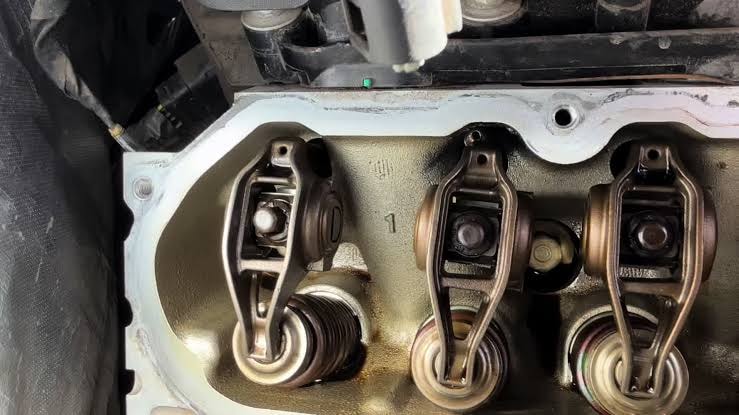
The rocker arm and valvetrain assembly of a Chevrolet 5.3L V8 with the valve cover removed — the kind of inspection that follows a professional diagnostic evaluation.
A Code Is Information, Not the Whole Answer
P0300 means the vehicle has detected a random or multiple-cylinder misfire. It doesn’t tell you whether the cause is a lifter, ignition component, fuel-delivery problem, compression issue or something else.
This is where the equipment used during an auction inspection can make a significant difference.
A basic OBD-II code reader can retrieve useful information, but professional automotive diagnostic equipment can provide considerably more. Depending on the scan tool and vehicle, it can communicate with multiple control modules, display live engine data, retrieve stored and pending diagnostic information, show cylinder-specific misfire data and provide access to manufacturer-specific functions.
Professional automotive diagnostic equipment is also readily available for purchase online. A buyer who wants capabilities beyond a basic code reader no longer has to depend on equipment found only in a dealership or repair shop.
That doesn’t mean every auction buyer needs to become an automotive technician. It means considerably more information can be available during an on-site inspection than simply mileage, warning lights and whatever appears in the auction description.
GM’s Own Procedure Goes Deeper
The L83 bulletin is particularly useful because GM doesn’t stop at P0300.
If the normal diagnostic process doesn’t isolate the cause, GM directs technicians to inspect valve operation. If a valve isn’t moving, the procedure moves into the AFM lifters and valve lifter oil manifold. GM also calls for inspection of the camshaft and lifters for excessive wear or damage.
That gives an auction buyer some perspective when inspecting an L83 Tahoe.
A ticking engine deserves attention. A misfire deserves attention. A stored P0300 deserves attention. But none of those observations by itself tells the complete mechanical story.
The more information you can gather during the inspection, the better you understand the Tahoe sitting in front of you.
Then Came the L84 and DFM
The redesigned 2021 Tahoe introduced the L84 5.3L and Dynamic Fuel Management.
GM published separate information for this engine in PIP5776H, dated March 9, 2023. The document covers the 2021 Tahoe equipped with the 5.3L L84 and identifies conditions involving misfire codes P0300 through P0308, a bent pushrod, a collapsed lifter or a lifter that has come apart internally.
This bulletin contains another piece of information an auction buyer can actually use: a specific production window.
GM identifies vehicles produced from September 1, 2020 through March 31, 2021. For vehicles within that window where diagnosis leads to the documented lifter condition, GM’s repair guidance differs according to mileage. Under 16,000 miles, the guidance calls for replacement of the lifters and guides on both banks. Above 16,000 miles, it calls for replacement on the affected bank.
That is the kind of manufacturer information worth researching before looking at a 2021 Tahoe.
Now the year, VIN, production date and mileage mean something together.
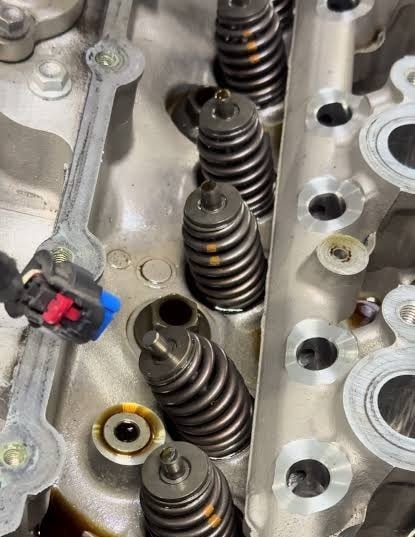
Valve springs exposed during engine disassembly on a Chevrolet 5.3L — GM’s service procedures direct technicians to inspect the camshaft and lifters for damage to lobes and rollers.
Start With the Exact Tahoe You’re Looking At
When researching a Tahoe before an auction, identify the exact vehicle rather than searching broadly for “Tahoe 5.3 problems.”
A 2018 Tahoe with an L83 and AFM is one thing. A 2021 Tahoe with an L84 and DFM is another.
Start with the VIN, model year, engine identification and mileage. If engine and idle hours are available, look at those too. Review the maintenance records when the selling agency provides them and find out how the Tahoe was used.
Then compare that information with the manufacturer service information applicable to that vehicle.
This is especially useful with government vehicles because odometer mileage doesn’t necessarily tell the entire story. A Tahoe used in police or public-safety service can accumulate substantial operating and idle hours while stationary. Its previous assignment can add even more context to those numbers.
A Tahoe assigned to investigations or administration can have a different service history from one used for patrol, traffic enforcement, K-9 or another operational assignment.
The vehicle’s history matters just as much as the number displayed on the odometer.
Take the Research to the Vehicle
The real value of researching the 5.3L isn’t memorizing bulletin numbers. It’s being able to use the information when you inspect the Tahoe.
If you’re looking at an L83, you already know about GM’s AFM lifter documentation. If you’re looking at a 2021 L84, you know about the DFM lifter information and the production window identified by GM.
Now inspect the vehicle.
Listen to the engine. Check the instrument panel. Use professional diagnostic equipment when available. Look at stored and pending codes and the live information available from the vehicle. Review the maintenance history and engine hours. Ask the fleet personnel about the vehicle’s service and repair history.
You’re no longer approaching the Tahoe as an unknown vehicle.
You have a starting point.
Why UXAuctions.com Includes This Research
This is exactly why UXAuctions.com includes vehicle-specific research as part of the auction process.
Finding a Tahoe for sale is one job. Understanding the Tahoe you’ve found is another.
Our research gives buyers a place to start before an on-site inspection. For the 5.3L Tahoe, that includes understanding the difference between the L83 and L84, AFM and DFM, GM’s published lifter information, the symptoms GM identifies and the diagnostic information that may be available from the vehicle.
Then you can take that information with you to the auction.
The research doesn’t have to be complicated. It simply has to be relevant to the vehicle you’re actually considering.
Know Which 5.3L Is Under the Hood
For a 2015–2020 Tahoe, you’re looking at the L83 5.3L with AFM. GM has documented conditions involving misfires, ticking, P0300, AFM lifters and bent pushrods.
For a 2021 Tahoe, you’re looking at the L84 5.3L with DFM. GM separately documented lifter-related conditions for certain vehicles produced from September 1, 2020 through March 31, 2021.
Those facts don’t tell you the condition of the Tahoe you’re considering.
The inspection does.
But knowing those facts before the inspection means you don’t arrive wondering where to start.
You arrive knowing what you’re looking at, what GM has documented, and where to begin your inspection.
That’s useful information when the next decision is whether to bid.
Auctions News Network Magazine